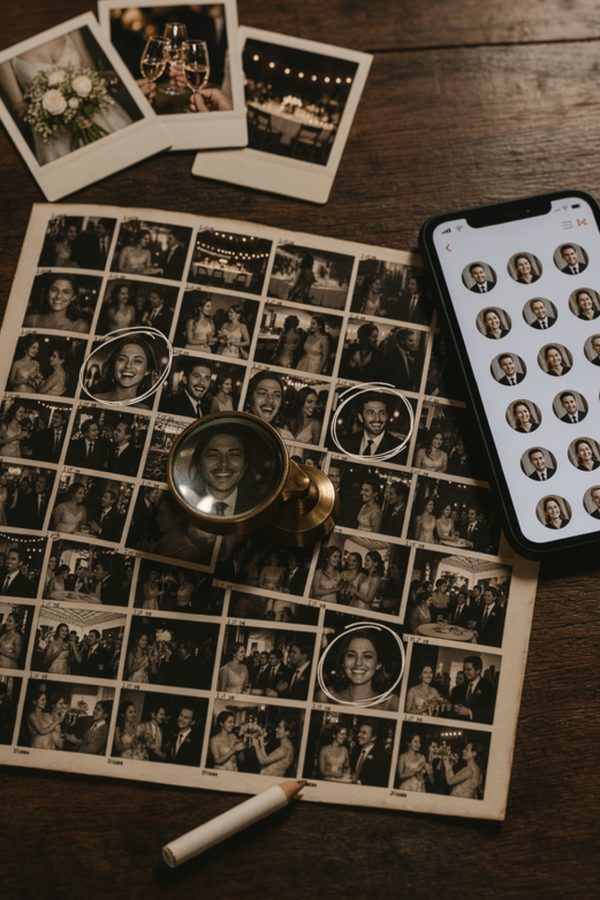
Face recognition itself has become standard. The real differences between services are in the details: trying before you pay, the final price, privacy, storage and quality. 10 questions to ask any provider, and what counts as a good answer.
A face-recognition photo gallery is a service where you upload all the event photos, and every guest takes a selfie and gets only the photos they appear in. Face recognition itself has become standard in this category, so the real differences between services are in the details: whether you can try before you pay, the final price, what happens to face data, how long the gallery stays up, and whether guests need an app. These are the 10 questions worth asking any provider before you pay.
The 10 Questions at a Glance
| Question | Why it matters | A good answer |
|---|---|---|
| Can we try before paying? | You see it working on your own photos | A free trial, no credit card |
| What's the final price? | Extras surface after you order | A published price and a clear list of extras |
| Do guests need an app? | Every extra step loses guests | A selfie in the browser, no sign-up |
| What happens to face data? | Biometric data is sensitive | A clear line between the selfie and gallery photos |
| How many photos, for how long? | A gallery that closes too early | Written limits, counted from publishing |
| Original quality? | Compression ruins photos for print | Full-resolution downloads |
| Can guests add photos? | The moments on guests' phones | A shared album via QR |
| What if recognition misses? | No face recognition is perfect | Browsing the whole gallery and by person |
| Who controls access? | Guests' private photos | Access code and deletion in the host's hands |
| How do photos reach the gallery? | Delays at a third party | Direct upload, gallery ready the same day |
1. Can We Try It on Our Own Photos Before Paying?
This is the first question because it answers all the others. The sample photos on every provider's site were picked because they work. The question is whether it works on your photos - in your venue's lighting, with your people. A good answer: you can create an event, upload a few dozen photos and watch face recognition find people, with no credit card.
2. What's the Final Price, and What Costs Extra?
A published price is a good start, but ask explicitly what it doesn't include: sending the link to every guest on WhatsApp, the photo limit, extending storage, branding, and collecting photos from guests. Ask too whether you pay per event or by subscription, and whether there's a sales call along the way.
3. Do Guests Need an App or an Account?
Every step along the way loses guests - especially older guests and kids. A good answer: the guest scans a QR or taps a link, takes a selfie in the browser, and gets their photos. No app to download, no account to create and nothing to pay.
4. What Happens to the Selfie and the Face Data?
Since August 2025, when Amendment 13 to Israel's Privacy Protection Law came into force, biometric data counts as "information of special sensitivity" in Israel. An accurate answer separates two things: the guest's selfie, which is used for matching and doesn't need to be kept; and the face data in the gallery photos, without which there's nothing to search. Ask too whether guests confirm consent before the selfie, whether matching happens only within the event, and whether the data is sold or passed to others.
An answer like "we don't store any biometric data" deserves a second look. To match a selfie to photos, the system needs a representation of the faces in the gallery photos - at least for as long as the event exists. A provider who explains that plainly is a provider who understands what it keeps.
5. How Many Photos Are Included, and How Long Does the Gallery Stay Up?
An average wedding produces thousands of photos, and guests come back to the gallery months later. Check the photo limit and the storage period - and when it starts counting. A period counted from purchase can run out sooner than expected if you bought months before the event.
6. Are Photos Kept and Delivered at Original Quality?
WhatsApp compresses photos, and some galleries only show a reduced version. A good answer: the guest downloads the photo at the full resolution the photographer uploaded, so it can be printed.
7. Can Guests Add Their Own Photos?
Many of the best moments are shot on guests' phones. Ask whether there's a shared album guests upload to via a QR at the event, how many photos each guest can upload, and whether it's included or extra.
8. What Happens When Recognition Misses?
Face recognition is a probabilistic technology: lighting, angles, sunglasses or hidden faces can cause misses. A provider claiming perfect accuracy isn't telling the whole story. A good answer: guests can also browse the whole gallery, filter by person, and try another selfie.
9. Who Controls Access to the Gallery?
Ask whether the gallery can be protected with an access code, whether the host can delete photos themselves (for example when a guest asks for a photo of them to come down), and what happens to all photos and data at the end of the period.
10. How Do Photos Reach the Gallery, and When Do Guests Get Them?
With some services, photos go through a representative or wait for approval. Ask who uploads the photos - you, the photographer or the magnet photographer - and how soon after upload guests can search for themselves. A good answer: you upload directly, and the gallery is ready the same day.
How Snapick Answers These Questions
| Question | Snapick |
|---|---|
| Try before paying | Yes - a trial event with up to 30 photos, no credit card |
| Price | ₪399 per event; Snapick Plus with full branding ₪599. One payment, no subscription |
| Extras | Automatic WhatsApp delivery of the link to every guest - from ₪49, arranged with us |
| App for guests | No - a selfie in the browser, no sign-up |
| The selfie | Used temporarily and not kept, after explicit consent |
| Face data in the gallery | Kept for the life of the event and deleted with it; not sold or passed to others |
| Photos and storage | Up to 5,000 photos and 6 months (Plus: 10,000 and 12 months), from publishing |
| Quality | Original-quality downloads |
| Photos from guests | A shared album via QR, up to 30 photos per guest - as a gift |
| When recognition misses | Browse the whole gallery and filter by person |
| Access | Access code, and deleting photos or the event in the host's hands |
Red Flags
- No published price, and you have to "leave your details" to find out the cost
- No way to see it working before you pay
- Guests have to download an app or create an account
- A vague answer about face data, or a promise that "nothing is stored"
- A promise of one hundred percent accuracy
FAQ
What is a face-recognition photo gallery?
A service where you upload all the event photos and the system recognizes who appears in each one. Every guest takes a selfie and gets a personal gallery of the photos they appear in, without scrolling through thousands of photos.
How much does a face-recognition photo gallery cost in Israel?
Going by the prices published on Israeli services' websites (autumn 2026), a package with face recognition usually costs a few hundred shekels per event. At Snapick it's ₪399 per event, or ₪599 with full branding, and you can try it free before you pay.
Do you need guests' consent for face recognition?
At Snapick every guest confirms explicit consent before uploading a selfie, and without it the search doesn't run. A guest who'd rather not can simply browse the gallery. Responsibility for the consent of people in the uploaded photos lies with the event owner, as set out in the terms of use.
Is face recognition in event galleries one hundred percent accurate?
No. Face recognition is a probabilistic technology, and lighting, angles or hidden faces can cause misses. That's why it matters that guests can also browse the whole gallery and filter by person.
Do you need a professional photographer to use a face-recognition gallery?
No. You can upload any photo from the event - from a photographer, a magnet photographer or phones - and the guest album collects the photos guests take themselves.